
Are You Delaying Your Pregnancy with These 5 Habits?

Home » Are You Delaying Your Pregnancy with These 5 Habits?

Are You Delaying Your Pregnancy with These 5 Habits?
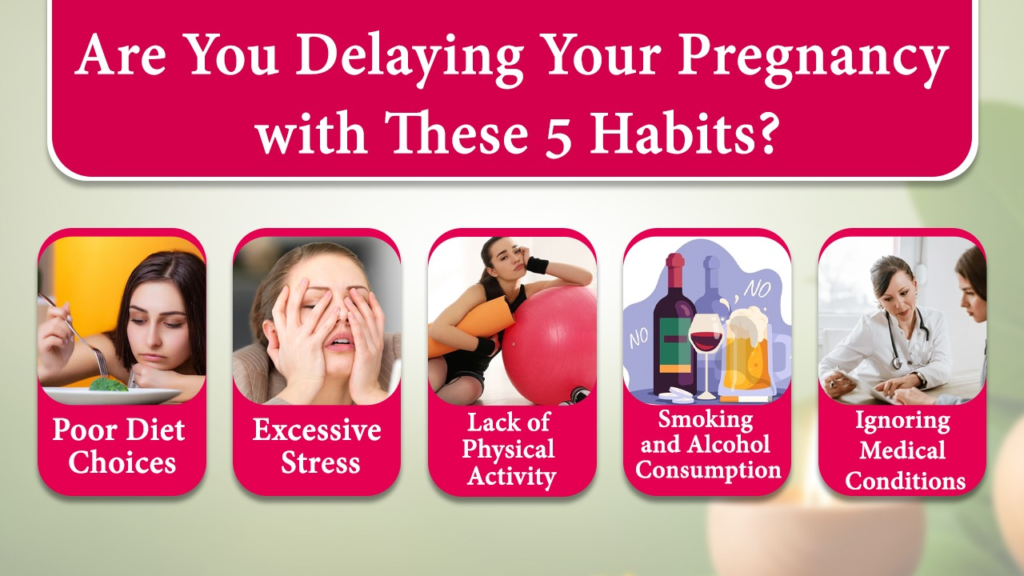
In today’s fast-paced world, many women and couples are facing challenges when trying to conceive. But do you know the reasons that affect your fertility? Nowadays people are more focussed on their career and goals and unintentionally they ignore their personal life, which might be one of the major reasons for infertility. Females have fixed ovarian reserves that decrease with increase in age, so after 30 women face problems in conceiving. Lifestyle is also one of the major factors that affects your fertility. At Aasha Ayurveda Clinic, we believe in a holistic approach to health, emphasizing the importance of lifestyle choices in reproductive health. In this article, we will discuss five common habits that might be delaying your pregnancy and how to address them.

1. Poor Diet Choices

Nutrition plays a crucial role in fertility. A diet high in processed foods, sugars, and unhealthy fats can lead to hormonal imbalances, affecting ovulation and sperm quality. You should always choose a healthy or balanced diet instead. That may include whole grains, green vegetables, fresh fruits and lean proteins, etc. these nutrient rich food items are very good for your reproductive health.  

Impact on Fertility:

  • Hormonal Imbalances: Diets high in unhealthy fats and sugars can disrupt hormone levels, leading to irregular menstrual cycles and ovulatory dysfunction.
  • Sperm Quality: If a man eats unhealthy food that lacks proper nutrition can lead to low sperm count.
  • Obesity: Excess body weight can lead to insulin resistance, affecting ovulation and increasing the risk of miscarriage.

Recommendations:

  • Incorporate antioxidant-rich foods like berries, nuts, and leafy greens.
  • Limit intake of processed foods and sugars.
  • ​​​​​​​Always try to eat healthy and modify your lifestyle according to your body’s needs. Avoid the sedentary lifestyle instead do regular exercise, yoga or meditation.

2. Excessive Stress

Chronic stress can interfere with the hormonal signals required for ovulation and sperm production. Additionally, stress can lead to unhealthy coping mechanisms like poor eating habits or lack of sleep, further impacting fertility.

Impact on Fertility:

  • Hormonal Disruption: Stress increases cortisol levels, which can interfere with reproductive hormones.
  • Menstrual Irregularities: When a woman takes more stress then there is a high chance of her missing her periods that can be an indication of irregular ovulation..
  • Reduced Libido: Stress can decrease sexual desire and frequency, reducing chances of conception.

Recommendations:

  • Practice relaxation techniques such as meditation, deep breathing, or yoga.
  • Do regular workout, it may help reduce stress levels.
  • Ensure adequate sleep and rest.
     

3. Lack of Physical Activity

Fertility can be affected by sedentary lifestyle, so if you want to maintain your fertility then start working out on a regular basis. Regular moderate exercise helps maintain a healthy weight, reduces stress, and improves overall reproductive health.

Impact on Fertility:

  • Weight Management: Regular exercise helps maintain a healthy weight, which is crucial for hormonal balance.
  • Improved Circulation: Physical activity enhances blood flow to reproductive organs, supporting their function.
  • Reduced Stress: Exercise is a natural stress reliever, which can positively impact fertility.

Recommendations:

  • You should start working out at least 30 minutes daily to avoid the risk of infertility. 
  • Include activities like walking, swimming, or cycling.
  • Avoid excessive high-intensity workouts that can disrupt hormonal balance.
     

4. Smoking and Alcohol Consumption

These days people are trying to be cool in public by starting smoking and drinking. But you need to be aware about the harmful effects of these two habits. Smoking and drinking can reduce your fertility. The substance found in cigarettes can lead to miscarriage, lower sperm count, poor egg quality, etc. 

Impact on Fertility:

  • Smoking: Contains toxins that can damage reproductive organs and reduce egg and sperm quality.
  • Alcohol: Excessive consumption can lead to hormonal imbalances and ovulatory dysfunction.
  • Increased Miscarriage Risk: Both smoking and heavy drinking increase the likelihood of miscarriage.

Recommendations:

Quit smoking and drinking. Try to avoid exposure to secondhand smoke.
Limit the consumption of alcohol as much as you can. 

Seek support if needed to help reduce or eliminate these habits.
 

5. Ignoring Medical Conditions

Certain medical conditions like polycystic ovary syndrome (PCOS), thyroid disorders, and endometriosis can affect fertility. Ignoring or delaying treatment for these conditions can prolong the time it takes to conceive.

Impact on Fertility:

  • PCOS: PCOS is the result of hormonal imbalance that can lead to irregular periods.
  • Thyroid Disorders: Both hypothyroidism and hyperthyroidism can disrupt menstrual cycles and ovulation.
  • Endometriosis: Can cause scarring and adhesions that can affect your ovaries, uterus, fallopian tubes or any reproductive organ.

Recommendations:

  • If you see any of these symptoms then immediately contact your healthcare professional for better results.
  • Once your doctor prescribes any treatment to you, try to follow it seriously and monitor your health regularly.
  • Consider lifestyle changes that support overall reproductive health.
     

Conclusion

While some factors affecting fertility are beyond our control, many lifestyle habits can be modified to improve reproductive health. At Aasha Ayurveda Clinic, we emphasize the importance of a balanced diet, stress management, regular physical activity, and avoiding harmful substances in supporting fertility. By making informed choices and seeking appropriate care, you can enhance your chances of conception and embark on the journey to parenthood with confidence.

Frequently asked questions (FAQs)

Q1. What can delay a woman from getting pregnant?

Ans: If a woman is not having regular periods then she might be delayed from getting pregnant because periods is the sign of ovulation that is a must for pregnancy. 

Q2. On which days there is no chance of pregnancy?

Ans: No one can predict the exact safe days when there is no chance of pregnancy but you can make relations during periods or just after periods to avoid the risk of pregnancy because a woman is less fertile during these days. 

Q3. Which fruit is not good for pregnancy?

Ans: Papaya is one of those fruits that is not good for pregnancy because it contains latex, that can harm the baby and the pregnant woman. 

If you want more information on this topic or other PCOS, tube blockages, or hydrosalpinx treatments. Visit our website aashaayurveda.com,

Consult our highly experienced and trained fertility specialists and gynecologists at these five  branches of Aasha Ayurveda in Delhi, Mumbai, Pune, Hyderabad and Lucknow for a completely confidential consultation and get the best treatment for PCOD, PCOS, or female infertility.

Similar Posts

  • Best Fallopian Tube Blockage Treatment in Hyderaba Telangana

    Best Fallopian Tube Blockage Treatment in Hyderabad The fallopian tubes are part of the female reproductive system that connect the uterus and ovaries. An egg goes from the ovary to the uterus via the fallopian tubes once a month during ovulation. This occurs in the middle of a period of menstruation cycle. Conception also happens…

  • Tube Blockage Clinic in Mumbai | Best Infertility Doctor in Mumbai – Aasha Ayurveda

    Tube Blockage Clinic in Mumbai | Best Infertility Doctor in Mumbai – Aasha Ayurveda The fallopian tube connects the uterus to the ovaries in a woman’s reproductive system. Fallopian tubes are the tubes that connect a woman’s ovaries to her uterus. The function of the fallopian tubes is crucial to the success of a pregnancy….

  • Ayurvedic Treatment for PCOD – Aasha Ayurveda Doctor Chanchal Sharma

    Ayurvedic treatment for PCOD || What is PCOD ? Nowadays , due to changing lifestyles , unhealthy food habits , and lack of physical activity , people are facing many problems . Especially if we talk about women , they have to juggle the responsibilities of home and family as well as work space , due to which they are unable to give time to themselves , and this gradually starts having a negative impact on their health . These small things that women keep ignoring can later lead to major health problems . One of these is PCOD . Let ‘s find out in this blog post what is PCOD , what are its causes , symptoms , and treatment ?​​​​​​​​                       What is PCOD ? ( PCOD kya hota h?) PCOD is a hormonal disorder that occurs in women of reproductive age ( 15 to 45 ) . The full form of PCOS and PCOD is Polycystic Ovarian Disease . To understand what PCOD is ( PCOD  kya hota hai ) , one must study this disease carefully . Under this disease , small cysts start forming in a woman ‘s ovaries , which look like lumps in shape .​​​   If PCOD is not treated promptly , itcanleadtoinfertilityinwomen.WomenwithPCODoftenexperienceirregularperiods,includingsevereabdominalpainandcramps.WomenwithPCODalsoexperienceincreasedlevelsofmalehormones,leadingtofacialhairgrowth,weightgain,andacne.​​​​​​​​​​​​​​​​​​​​​​​​​​​​​​​​   What are the causes of PCOD ? (PCOD ke karan kya hote hain ?)  What are the symptoms of PCOD ? (PCOD ke lakshan kya hote hain and what is PCOD problem?)  PCOD is a common condition in women caused by hormonal imbalance and has many symptoms . To understand PCOD , it ‘s important to understand its symptoms . PCOD symptoms can vary from woman to woman , depending on their physical condition , genetics , and other factors . Here are some common symptoms of PCOD :​​​​​​​​​​​​​​       How long does the treatment of PCOD last / in how many days does PCOD get cured ?  PCOD has become quite common these days . It is a hormonal imbalance – related disorder that is treatable . However , to fully resolve it , patients may need to make some lifestyle changes . Women with PCOD should exercise regularly and pay special attention to their diet . Ayurveda uses herbal remedies to treat PCOD . Maintaining control is essential in this situation .​​​​​​​​​​​​​​​   How to diagnose PCOD ?​ To properly treat PCOD , you must first understand its causes . To understand the causes of PCOD , you need to pay attention to its symptoms . If you experience any of the  above symptoms , consult a gynecologist . Your healthcare provider may recommend the following tests :​​​​​​​​ How is PCOD treated ?​​​ Treatment for PCOD can vary from woman to woman , depending on the symptoms . Because a complete cure for PCOD is n’t possible , the symptoms determine the appropriate treatment . You can manage its symptoms by leading a healthy lifestyle and eating healthy foods . Here are some lifestyle changes you can make to help manage PCOD :​​​​​​​​​​​​​​​​​​​​​​​​​​   Can women with PCOD become pregnant ?​​​  Women often wonder whether they can become mothers after being diagnosed with PCOD . This question is valid , as this hormonal disorder affects lifestyle . Women with PCOD may take longer to conceive than other women . They may face various complications during pregnancy . Therefore , they especially need to make lifestyle changes to help them achieve their dream of becoming a mother .​​​​​​​​​​​​​​​​​​​​​​​​​​​   Not all women with PCOD have the same symptoms , so conceiving is easier for some . Some women with PCOD have irregular periods , making it difficult to track their ovulation . Without a track record of ovulation , it becomes difficult for them to know their most fertile days , the days when intercourse will most likely lead to pregnancy .​​​​​​​​​​​​​​​​​​   Ayurvedic Treatment of PCOD​​  Ayurvedic treatment aims to eradicate any disease from its roots . The underlying cause is first identified , then treated to permanently free you from the disease . Treatment is often tailored to the individual ‘s abilities , which can vary . However , it is recommended that you consult an Ayurvedic specialist before undertaking any therapy or medication , as this reduces the risk .​​​​​​​​​​​​​​​​​​​​​​​​​​   Panchakarma treatments are recommended to treat the underlying cause by removing toxins from the reproductive system and strengthening various organs such as the uterus , ovaries , and fallopian tubes . This Panchakarma treatment also helps maintain the body ‘s hormonal balance .​​​​​​    Conclusion​ This disorder , caused by hormonal imbalance , can affect any woman in the reproductive age group . Women affected by this disorder develop cysts in their ovaries , causing significant discomfort during their periods . Treatment is possible , but lifestyle changes are crucial . You need to adopt a healthy lifestyle and exercise regularly to maintain hormonal balance .​​​​​​​​​​​​​​​   Which test is done to check PCOD ? ​​​ To check PCOD , the doctor does a physical examination , blood test and measures the level of LH ( luteinizing hormone ) present in the blood .    FAQs  :  Frequently Asked Questions​​ Q. What is the problem caused by PCOD ?  PCOD is a hormonal imbalance disorder that can affect women between the ages of 15 and 45. PCOD causes irregular periods , severe abdominal pain , and cramps during periods . They may also develop unwanted facial hair and pimples .​​​​​​​​​​​​​​​​​​​​   Q.  How will I know if PCOD has been cured ?​ …

  • Best Infertility Doctor in Mumbai – Aasha Ayurveda

    Ayurveda defines infertility as a woman’s biological inability to contribute to conception and to bring a pregnancy to term. In modern medical terms, infertility is defined as a couple’s inability to conceive a child after one year of continuous sexual activity without contraception. According to the best infertility doctor in Mumbai, ovulation problems are women’s most…

  • Male Infertility? Try These Natural Ways To Increase Your Sperm Quality

    Male  infertility  try  these  natural ways  to  increase  your sperm quality In this article:   What Is Male Infertility? A male is called infertile when he fails to impregnate his female partner with frequent and unprotected sex for a year or longer. The health of sperm is important for male infertility. Things that include health…

Leave a Reply

Your email address will not be published. Required fields are marked *